Food
Bari Street Food: What to Eat in Bari and Where
Warm focaccia, sgagliozze in a paper cone, raw seafood by the harbour: Bari is eaten on the street. Where to go, what to order and what it costs.
If you are wondering where to eat in Bari, the short answer is Bari Vecchia, the old town, because that is where almost all of the city’s street food is. You buy focaccia from the historic bakeries in the old centre, sgagliozze and popizze between Strada delle Crociate and Largo Albicocca, panzerotti around piazza Mercantile and piazza del Ferrarese, and handmade orecchiette in Strada Arco Basso. Raw seafood is tied to the San Nicola pier (molo San Nicola), which is closed for works from 5 October 2026 to 30 May 2027. For the octopus sandwich you head to the seafront, for spaghetti all’assassina to the Murattiano district, and apart from seafood almost everything costs a few euros.
Focaccia barese: what it is and where to eat it
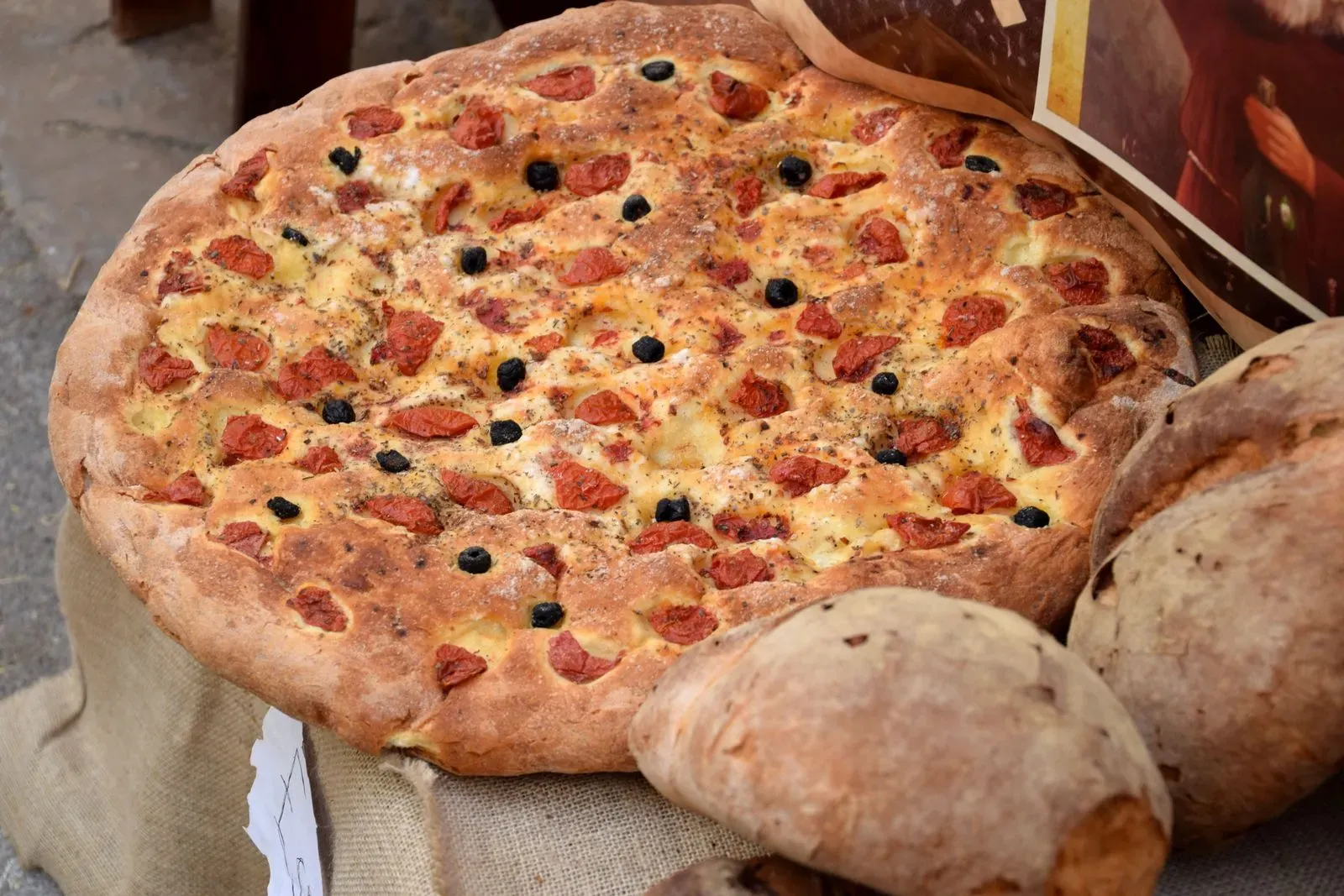
Focaccia barese is made from re-milled durum wheat semolina, boiled potatoes, water, yeast and salt, baked in a round tin with plenty of extra virgin olive oil, and it comes out one to three centimetres tall, crunchy underneath and soft inside. The classic version is topped with cherry tomatoes and olives, but there is also one with sliced potatoes and a plain one with coarse salt and rosemary.
In Bari Vecchia the names that come up most often are Panificio Fiore, on Strada Palazzo di Città, and Panificio Santa Rita, on Strada dei Bianchi Dottula, known for its thin focaccia, and both are among the city’s century-old bakeries. Queues build up mid-morning and again around 5 pm, when the hot focaccia comes out of the oven. If you want to try a different take, Panificio Violante in the Madonnella district makes it without cherry tomatoes, with tomato sauce instead.
On price, it helps to know what to expect: in May 2026 a slice in the old town cost around €4 and a whole round went up to €12, while neighbourhood bakeries away from the tourist flow charge less.
Panzerotto: eat it upright
A panzerotto is a half-moon of leavened dough filled with mozzarella and tomato and deep-fried, and the name comes from “panza”, belly, because it puffs up in the oil. Since 2012 it has been listed as a traditional food product (PAT) of Puglia.
Eat it piping hot and hold it upright, otherwise the filling runs everywhere. The fry shops cluster around piazza Mercantile and piazza del Ferrarese, where the nightlife is, and besides the classic you will also find one filled with braciola, a beef roll cooked in tomato sauce. Expect to pay between €1 and €3.50, depending on the filling and the place.
Sgagliozze and popizze, the fried snacks of the old town
Sgagliozze are slices of polenta about half a centimetre thick, cut into squares or rectangles, fried, salted and served in a paper cone, and since 2017 they have been a PAT of Puglia too. Tradition links them to the feast of Saint Nicholas on 6 December, when they were sold to people leaving mass at the Basilica. According to her family, the woman who spread them around Bari Vecchia was Giuseppina Amoretto, known as “Finella”, who from the 1940s fried polenta near the Arco di San Pietro after discovering it in Milan during the war.
Popizze are the Bari name for pettole, balls of very soft leavened dough dropped by the spoonful into boiling oil and then salted. They are associated with Christmas, but you can find them all year round.
Both are sold by the women who fry them outside their front doors, mostly in Strada delle Crociate and Largo Albicocca, from late afternoon. A cone of sgagliozze usually costs €1-2 for 7-10 pieces, and since many street stalls only take cash, it is worth keeping some on you.
Raw seafood and the San Nicola pier
Crudo, “u crud” in dialect, is probably the most Barese ritual of all, and the typical plate brings together allievi, curled octopus, black and bearded mussels, oysters, noci and taratuffi (two local clams) and prawns, with lemon.
Allievi are often described as “baby cuttlefish that haven’t grown up yet”, which is not quite right. They are actually three species of small cuttlefish, and two of them stay small even as adults.
Polpo crudo arricciato, raw curled octopus, has been a PAT of Puglia since 2022, and making it takes time: the octopus is beaten on stone, rubbed for a long while and swung in a basket until the tentacles curl. It is not a recent trend either, because “pulpo rizzuto” already appears in Bari’s city regulations of 24 October 1513.
The historic home of crudo is the San Nicola pier, known as “N’dèrr a la lanze”, “down by the boats”, because this is where fishermen sold their catch at the foot of their boats. People came in the morning, with a Peroni in hand.
New for 2026: the pier is a building site until May 2027
From 5 October 2026 to 30 May 2027 the concessions on the San Nicola pier, by the Teatro Margherita, are suspended for redevelopment works. The historic kiosk El Chiringuito moves to a temporary structure in the Fabrizio De André gardens, a few steps away. The fishermen keep their gear boxes, but where they will sell crudo during the works is still unclear, so it is best to ask locally before you go. Once finished, the project includes dedicated spaces for preparing and selling the catch.
Sea urchins: fishing is banned in Puglia until 2029
In June 2026 the Puglia Region extended the ban on sea urchin fishing until 30 June 2029, so any sea urchins you find in Bari come from outside the region, for example from Croatia or Galicia. In March 2026 they sold for €1 to €6 each at retail, and asking where they come from is perfectly normal. Date mussels (datteri di mare) are another story, since they are banned outright, and checks in Bari have fined customers as well.
How to eat raw seafood safely
Fish and cephalopods served raw must be blast-frozen, for example at −20 °C for 24 hours, to remove the risk of anisakis. Freezing does not kill bacteria and viruses, though, which is why raw bivalves, meaning mussels, oysters, noci and taratuffi, remain the most delicate, especially for hepatitis A. In 2026 Bari’s local health authority (ASL) stepped up checks on the mussel supply chain.
The advice is simple: buy from licensed restaurants and fishmongers, ask where the bivalves come from and, if you are pregnant, travelling with small children or have a weakened immune system, go for cooked seafood.
The octopus sandwich on the seafront is a recent invention
The panino con polpo, an octopus sandwich, looks like an old dish, but compared with crudo it is a recent invention, and you find it all over Puglia. In Bari it is mostly eaten on the seafront, towards Largo Adua, and in the centre, where some sandwich shops serve it with burrata and other ingredients. Expect to spend €7.50 to €12.
Strada Arco Basso: handmade orecchiette and the new rules
In Strada Arco Basso, between the Basilica of San Nicola and the Swabian Castle, women make orecchiette by hand in front of their doorways, and it is one of the most famous sights in Bari. The rules have changed in recent years, though, and they are worth knowing before you buy.
In autumn 2024 some press investigations documented factory-made orecchiette being sold as handmade, and in 2025 the city council ruled that making pasta in the street is for demonstration only, and that it may be sold only if it is produced in home kitchens registered as food businesses. In August 2025, 151 kilos of apparently factory-made goods were seized. Some of the pasta makers have since got their paperwork in order, and in September 2026 the street is still lively.
Watching costs nothing. If you buy, ask whether the pasta is handmade, prefer sellers who display their licence and always ask before taking photos.
Spaghetti all’assassina and trattoria classics
Spaghetti all’assassina, “killer’s spaghetti”, is not street food, but it is the most searched-for dish in Bari, and leaving it out of a guide on what to eat in Bari would be odd. It was born in 1967 at the restaurant Al Sorso Preferito, in the Murattiano district, created by Enzo Francavilla, a chef from Foggia. The technique is unorthodox, because the dry spaghetti cooks in an iron pan with tomato broth added a little at a time, until it turns charred and crunchy.
The name comes from the chilli heat, since two diners called the cook an “assassino”, a killer. Forgotten from the 1980s onwards, it came back into fashion after 2013, the year the Accademia dell’Assassina was founded.
In trattorias you will also find tiella di riso, patate e cozze, rice, potatoes and mussels baked in layers, and orecchiette al ragù di braciole, orecchiette with a beef roll sauce, which is Bari’s Sunday lunch. As for the tiella, the idea that it comes from Spanish paella is an undocumented hypothesis, and it should be taken as such.
Sweets, gelato and Peroni
Sporcamuss, “dirty snout”, is a square of warm puff pastry filled with custard and dusted with icing sugar, and the name says it all. For gelato there is Gelateria Gentile in piazza Federico II di Svevia, facing the Castle, in business since 1880. Peroni beer has been brewed in Bari since 1924, and focaccia, crudo and Peroni are still the locals’ savoury breakfast.
Some dishes that guides attribute to Bari, however, come from other parts of Puglia. Tette delle monache are from Altamura, caffè leccese is from Salento and bombette are from the Itria Valley, so if you see them on a list of Bari specialities, something is off.
What to eat in Bari in one day
- Morning: hot focaccia from a bakery in Bari Vecchia, then crudo and Peroni, keeping the pier works in mind.
- Lunch: orecchiette al ragù or tiella in a trattoria, or an octopus sandwich on the seafront.
- Afternoon: a walk down Strada Arco Basso and gelato in front of the Castle.
- Evening: sgagliozze and popizze in Strada delle Crociate, a panzerotto in piazza Mercantile, spaghetti all’assassina in the Murattiano.
To get between Bari Vecchia, the seafront and the Murattiano, you can check on Bari Smart when the next bus is due.
Bari street food at a glance
| Dish | Where to eat it | Typical price |
|---|---|---|
| Focaccia barese | Bakeries in Bari Vecchia and neighbourhood bakeries | Slice around €4 in the old town (May 2026), less elsewhere |
| Panzerotto | Piazza Mercantile, piazza del Ferrarese | €1-3.50 |
| Sgagliozze (fried polenta) | Strada delle Crociate, Largo Albicocca | €1-2 for 7-10 pieces |
| Popizze (fried dough balls) | Strada delle Crociate, Largo Albicocca | A few euros a cone |
| Crudo (raw seafood) | San Nicola pier (closed until 30 May 2027) and fishmongers | €10-20 per person |
| Sea urchins | Fishmongers and restaurants (imported only) | €1-6 each (March 2026) |
| Octopus sandwich | Seafront, city centre | €7.50-12 |
| Handmade orecchiette | Strada Arco Basso | Varies, ask first |
| Spaghetti all’assassina | Trattorias, Al Sorso Preferito (Murattiano) | Restaurant prices |
Prices are indicative and vary a lot between tourist areas and the neighbourhoods, and many street stalls only take cash.
All things considered, a day on foot in Bari Vecchia covers almost all of the city’s street food. It makes sense to focus there if you are after focaccia, fried snacks and orecchiette for a few euros; less so if the main reason for your trip is crudo at the pier between October 2026 and May 2027, because during that period it pays to check before you travel.
Frequently asked questions
What is the most famous street food in Bari?
Focaccia barese with cherry tomatoes and olives is the symbol of the city. Right behind it come the fried panzerotto, sgagliozze (fried polenta) and crudo, raw seafood, especially the curled octopus.
Where can I find the best focaccia in Bari?
The most cited historic bakeries are in Bari Vecchia: Panificio Fiore on Strada Palazzo di Città and Panificio Santa Rita on Strada dei Bianchi Dottula. For the version with tomato sauce there is Panificio Violante, in the Madonnella district. Either way, buy it hot, in late morning or around 5 pm.
What are sgagliozze?
They are slices of polenta, fried, salted and served in a paper cone, and since 2017 they have been a traditional food product of Puglia. You find them mostly in Strada delle Crociate and Largo Albicocca, from late afternoon.
Is it safe to eat raw seafood in Bari?
Yes, if you buy from licensed businesses. Raw fish and cephalopods must be blast-frozen against anisakis, while raw bivalves such as mussels, oysters and clams remain the most delicate product for hepatitis A. If you are pregnant, travelling with small children or have a weakened immune system, cooked seafood is the safer choice.
Is the San Nicola pier open in 2026?
From 5 October 2026 to 30 May 2027 the San Nicola pier is closed for redevelopment works. El Chiringuito moves to a temporary kiosk in the De André gardens, while where the fishermen will sell during the works has not been clarified yet.
Can you buy orecchiette from the women in Arco Basso?
Yes, but since 2025 sales are allowed only for those who produce in premises registered as food businesses. Ask whether the pasta is handmade, prefer sellers who display their licence and ask permission before taking photos.